


Why have milk prices been so low lately?
February 27, 2026 | Davis, California
By Colton Adams, Research Economist
Since all of us have dealt with inflation in recent years, the average person may find it confusing to hear that farmers’ milk prices (farmgate milk prices) have been decreasing.
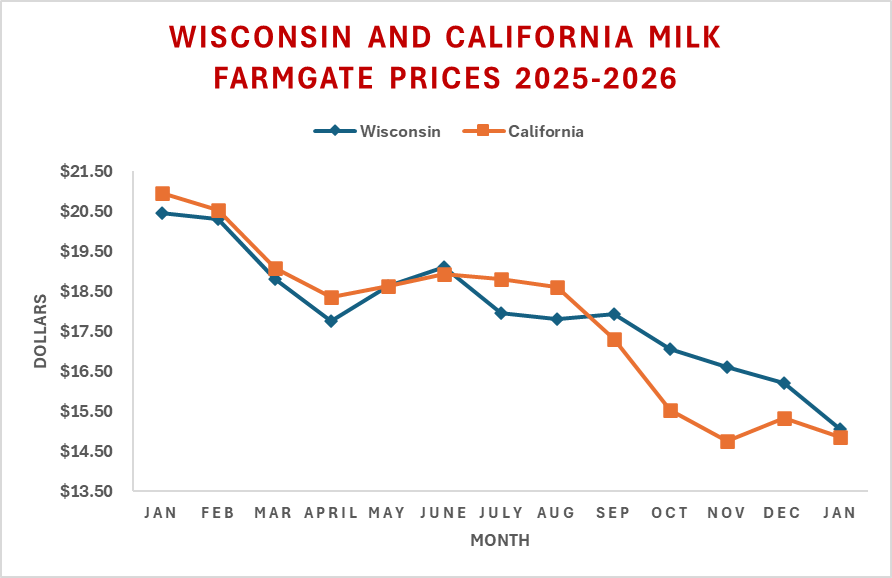
The figure below illustrates the decline in Wisconsin and California, the two states that produce the most milk. In January 2026, the farmgate price was $15.05 in Wisconsin and $14.85 in California. Even though feed costs, which are typically the largest expense for dairy farmers, have been low since the latter half of 2025, the decrease in milk prices has dampened farmers’ ability to receive higher profits. Farmers’ incomes were supported by beef sales and higher calf prices driven by the beef-on-dairy trend. So why have farmgate prices dropped?
Many sources indicated that there is an oversupply of milk. In the US, increasing herd sizes led to more production, with California having the largest production increase. Total milk production does not seem to decrease in the nearby future; in fact, the U.S. is estimated to reach 234.5 billion pounds in 2026. Additionally, most of the other large milk producers in the world have also exhibited increased output. This oversupply puts downward pressure on farmgate milk prices.
Interestingly, the global oversupply of milk outweighs the impact of recent dairy demand trends. In 2024, total fluid milk sales increased for the first time since 2010. According to the USDA, approximately 43.2 billion pounds of milk were sold in 2024, up from 42.8 billion pounds in the previous year. A wide range of US dairy products, like cheese, butter, and lactose, have seen their export sales soar to $9.51 billion in 2025. Dairy proteins from whey powder have seen higher demand recently as GLP-1 products (such as yogurt) have become increasingly popular as consumers seek healthier diets. The updated dietary guidelines released in early January by the USDA and HHS (which encourage full-fat dairy and double the recommended number of proteins to be consumed daily) will likely fuel these demand trends further. Despite all these demand trends, the annual all-milk price for the US is forecasted to decrease in 2026. Annual prices of various dairy products are also expected to decrease over the course of 2026, except for dry whey and nonfat dry milk, which are forecast to increase.
It is unknown when lower milk prices will translate to lower prices of dairy products for consumers at retailers, and whether milk producers across the globe will begin to reduce milk production. It is expected that low milk commodity prices will trigger demand to catch up to the supply surplus at some point in 2026.
For more information about the US and global dairy industries visit the USDA ERS dairy outlook, the USDA ERS dairy data, FAO, the USDA FAS, the USDA AMS, and the IDFA.