


They Explained Everything. Consumers Rejected Them More
By Abhipsita Das, Assistant Professor of Practice | Texas – July 22, 2026
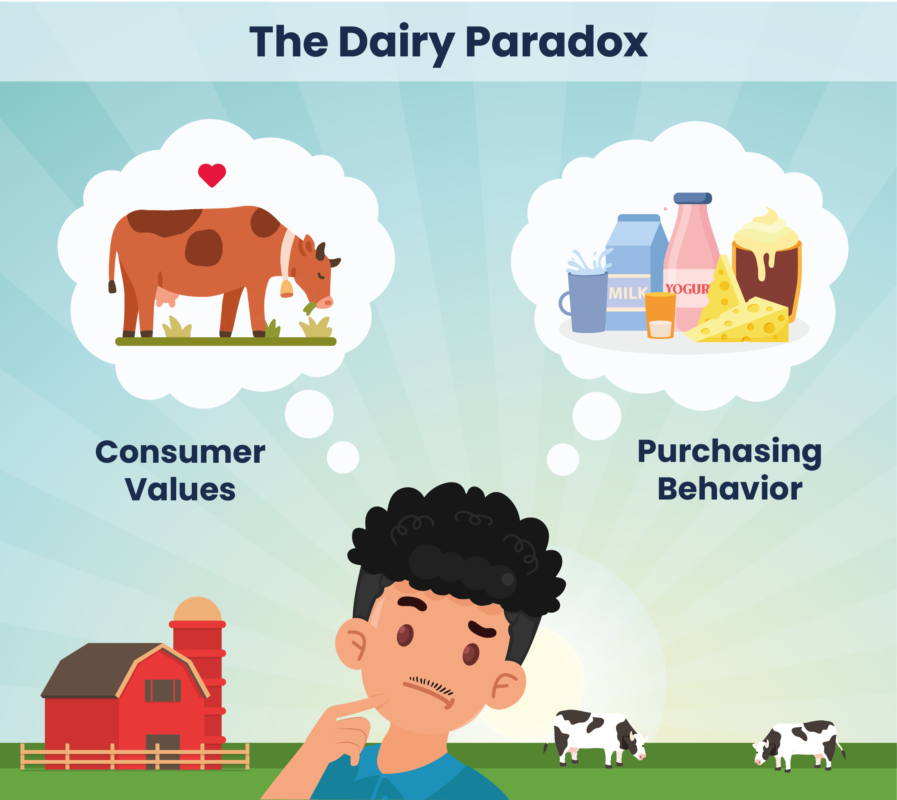
Consumer perception remains one of the most prevalent challenges of the dairy industry. Researchers refer to this as the Dairy Paradox: many consumers express genuine concern for animal welfare and the environmental footprint while continuing to purchase dairy products. In lieu of resolving that contradiction by pivoting to plant-based alternatives, consumers often justify this contradiction by adopting one of the five rationalization strategies (Five N’s): milk tastes good and that is enough (nice), dairy is natural and normal, dairy is nutritionally necessary and the negative environmental impact is neglectable. This psychological process, known as cognitive dissonance, helps explain why consumer attitudes and purchasing decisions often do not match.
Another common justification that consumers state is the belief that an individual’s purchasing decision has little impact because much larger sources contribute more to environmental problems. This helps explain why a person can express strong concern about animal welfare or climate change in a survey and still purchase conventional milk later that same day. This does not mean consumers are being dishonest or inconsistent, it simply shows that people often hold conflicting beliefs at the same time.
This finding has an important implication for dairy producers. If the gap between what consumers say and what they buy was simply caused by a lack of information, the solution would be straightforward: provide more education and explain the science behind dairy farming. However, research suggests the opposite can happen.
A study published in the Journal of Dairy Science by Hötzel, Cardoso, Roslindo, and von Keyserlingk, (2017) examined whether explaining common dairy management practices would increase public acceptance. Participants first shared their opinions about practices such as zero-grazing, in which cows are housed indoors year-round, and cow-calf separation, where calves are separated from their mothers shortly after birth. Both practices are supported by legitimate economic and animal-health considerations and are widely practiced across the dairy industry.
Before receiving any information, 75.7% of participants rejected having cows indoor all year-round as management practice. After providing the explanation of why this practice is implemented, rejection rose to 86.1%. More information produced more opposition, not less.
— Hötzel, Cardoso, Roslindo, & von Keyserlingk (2017), Journal of Dairy Science
Researchers then explained the economic, nutritional, and animal health reasons behind these two practices. Instead of becoming more accepting, participants became more opposed to zero-grazing. Before receiving the explanation, about 76% rejected zero-grazing. After reading the information, opposition increased to 86%. In other words, providing more technical information made consumers less supportive, not more.
Researchers believe this happens because many consumers make decisions based primarily on their values rather than on technical or economic facts. They are not asking whether a production practice is efficient or profitable; they are asking whether it feels morally right. When information conflicts with deeply held values, additional facts alone rarely change opinions and may even reinforce existing beliefs.
So, what could work instead? A review by Stampa, Schipmann-Schwarze, and Hamm (2020) found that consumers respond more positively to messages emphasizing visible commitments to animal welfare, environmental stewardship, biodiversity, family farming, and responsible production. These are qualities consumers cannot easily verify in a grocery store, so they rely on trust. Messaging that leads with naturalness, heritage, and genuine care has a demonstrably better chance of bridging the gap between what consumers say they value and what they actually pay for.
The Dairy Paradox also has important business implications. Dairy producers must decide whether investments such as pasture access, animal welfare certification, or carbon labeling will generate enough value to justify their cost. Consumer surveys alone cannot fully answer that question because stated preferences do not always translate into purchasing behavior. Consumers who express strong concern about animal welfare may be expressing a genuine value while having no intention of paying premium for them when making purchasing decisions.
Research by Payró and colleagues (2024) illustrates how large the gap between stated preferences and actual behavior can be. Their scenario analysis estimated that replacing cow’s milk with soy milk could reduce environmental impacts by about 8% under a specific set of assumptions. However, after accounting for the purchasing behavior of different demographic groups, the estimated reduction declined to approximately 0.8%. It is important to note that the study was designed to illustrate how actual consumer behavior can substantially alter the expected outcomes of theoretical models/scenario analysis. It does not suggest that one production system is inherently superior to another, as both dairy and plant-based sectors continue to adopt practices aimed at improving environmental quality.
To better understand this gap, members of the Louis Lab are analyzing Nielsen retail scanner and household panel data to measure what consumers actually purchase rather than what they report in surveys. By comparing stated preferences with real purchasing decisions, the research aims to provide dairy producers with evidence-based insights that can support more effective marketing, production, and investment decisions.
Sources
Hötzel, M. J., Cardoso, C. S., Roslindo, A., & von Keyserlingk, M. A. G. (2017). Citizens’ views on the practices of zero-grazing and cow-calf separation in the dairy industry: Does providing information increase acceptability? Journal of Dairy Science.
Kunze, G. (2022). The Dairy Paradox. Wageningen University.
Payró, C., Taherzadeh, O., van Oorschot, M., Koch, J., & Marselis, S. (2024). Consumer resistance diminishes environmental gains of dietary change. Environmental Research Letters, 19, 054033.
Stampa, E., Schipmann-Schwarze, C., & Hamm, U. (2020). Consumer perceptions, preferences, and behavior regarding pasture-raised livestock products: A review. Food Quality and Preference.