


Dr. Luis presents study on carbon taxes and incentives at IMDEA
By Jose Briceño, Communication Specialist | Madrid, Spain – May 27, 2026
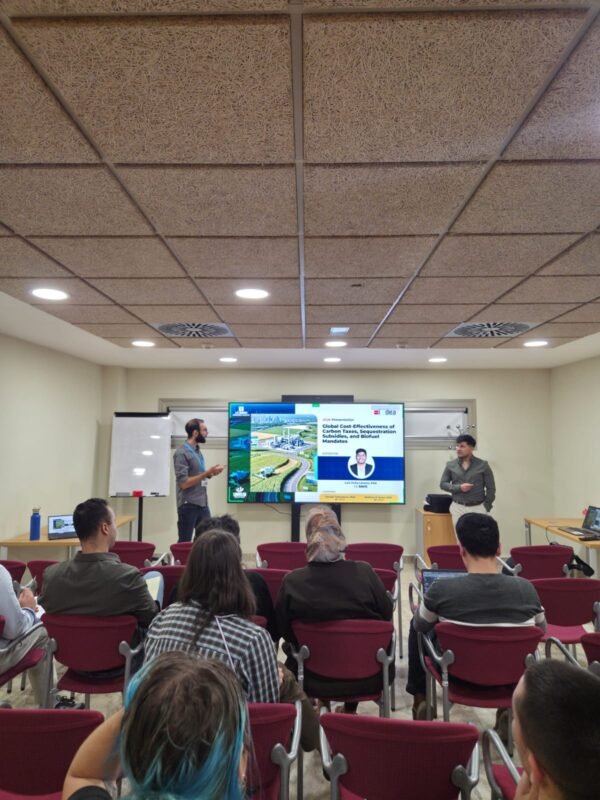
Dr. Luis Peña-Lévano visited the campus of the Water Research Institute (IMDEA Agua) in Alcalá de Henares, Spain, on April 23, 2026, to deliver a workshop based on his recent study, “Global Cost-Effectiveness of Carbon Taxes, Sequestration Subsidies and Biofuel Mandates.” The one-hour session was organized by Dr. Francesco Sapino, researcher at IMDEA Agua, and brought together more than 20 researchers from the institute, including participants from Spain, Italy, and Algeria.
During the presentation, Dr. Peña-Lévano discussed the advantages and limitations of three major agricultural mitigation strategies–carbon pricing, carbon sequestration incentives, and biofuel mandates–and explained how these policies can be evaluated using GTAP-BIO-FCS, a computable general equilibrium (CGE) model designed to estimate the global economic and environmental impacts of mitigation policies.
The study highlighted several important findings. First, while biofuel mandates can contribute to reducing greenhouse gas emissions, their effectiveness is constrained by competition for cropland and changes in subsidy structures. Second, carbon sequestration incentives can encourage forest expansion and carbon capture, although their mitigation potential eventually reaches an upper limit. Third, sequestration subsidies can help lower the economic cost associated with carbon taxes. Finally, the study showed that increased competition for land associated with carbon sequestration policies can substantially increase food prices.
Louis Lab thanks IMDEA Agua for the opportunity to share these findings and engage with researchers on the global challenges surrounding climate mitigation and their impact on food security.