


Why Chile Imports More Than Half of Its Beef Consumption?
Miwa Oizumi, Student Fellow | Davis – August 26, 2026
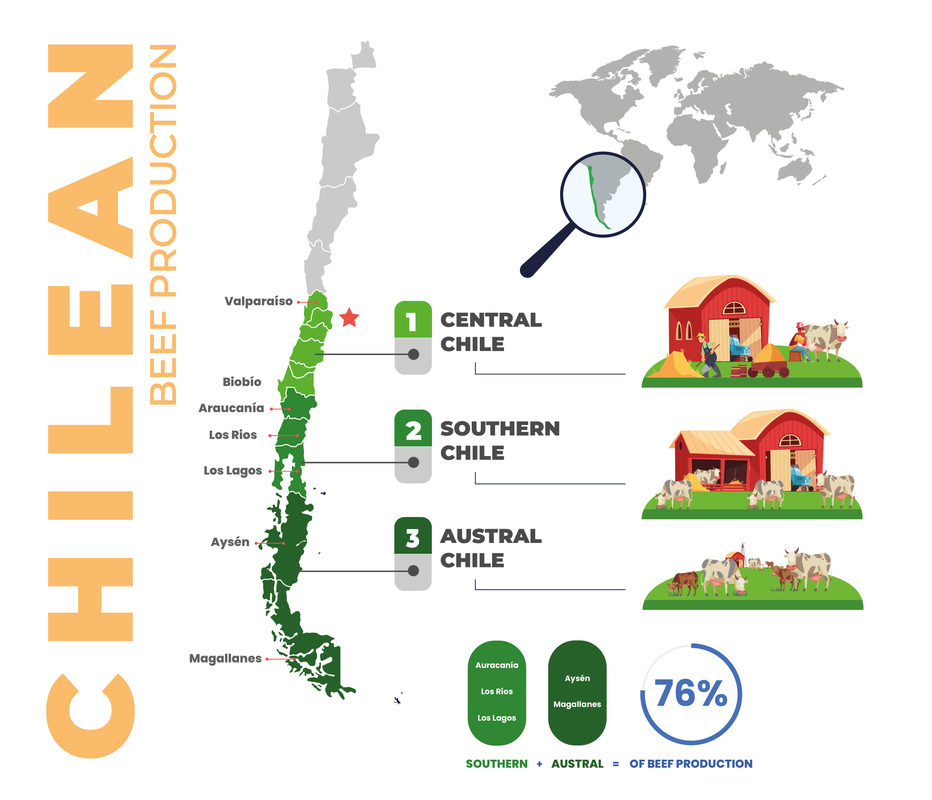
The Chilean beef industry reflects the unique country geography. Stretching more than 4,000 kilometers from north to south, Chile spans an incredible range of climates, landscapes and biodiversity that have shaped the cattle production system. More intensive operations are concentrated in central Chile, while the southern region relies primarily on extensive pasture-based grazing.
Most of the cattle are raised in southern Chile, where abundant natural pastures provide ideal conditions for producing high quality, grass-fed beef (Toro-Mujica 2019; Arias 2024). Interestingly, Chile’s industry is still largely supported by small- and medium-sized family farms, making this enterprise an important source of rural livelihoods while also giving the country strong potential for sustainable livestock production (Morales 2026). However, domestic cattle numbers have declined over the past two decades as producers face changing land use, climate related pressures, and increasing competition from imported beef (Morales 2026; Arias 2024).
Particularly, more than half of the beef currently consumed in Chile is imported from Brazil and Paraguay, even though beef demand continues rising (Arias 2024). The current beef classification system offers few rewards for producing higher quality meat, making it harder for Chilean producers to compete in premium export markets (Arias 2024). In addition, market concentration is affecting heavily smaller producers as this gives processors greater bargaining power and limits the prices farmers receive for their cattle (Panizza 2014).
Despite this, producers continue adopting regenerative grazing, silvopastural systems, and other sustainable practices. Thus, although the industry has opportunity to grow production, this will require market support, better incentives for quality production, and policies that help local farmers remain competitive.
References:
Arias, Rodrigo. 2024. «Beef Production and the Beef Evaluation System in Chile: Description, Characterization, and Quality.» Animal Frontiers 14 (2): 21–28. https://doi.org/10.1093/af/vfae003
Morales, Rodrigo, et al. 2026. “Sustainable Livestock Farming in Chile: Challenges and Opportunities.” Sustainability 18 (3): Article 1626. https://doi.org/10.3390/su18031626.
Panizza, Rodrigo. 2014. Market Power Estimation in the Chilean Cattle Market. Master’s thesis, Purdue University.
Toro-Mujica, Paula, et al. 2019. “Trends and Drivers of Change of Pastoral Beef Production Systems in a Mediterranean-Temperate Climate Zone of Chile.” Animals 9 (12): Article 1135. https://doi.org/10.3390/ani9121135