


New World Screwworm Raises Risks for U.S. Livestock
By Colton Adams, Research Economist | Davis – August 10, 2026
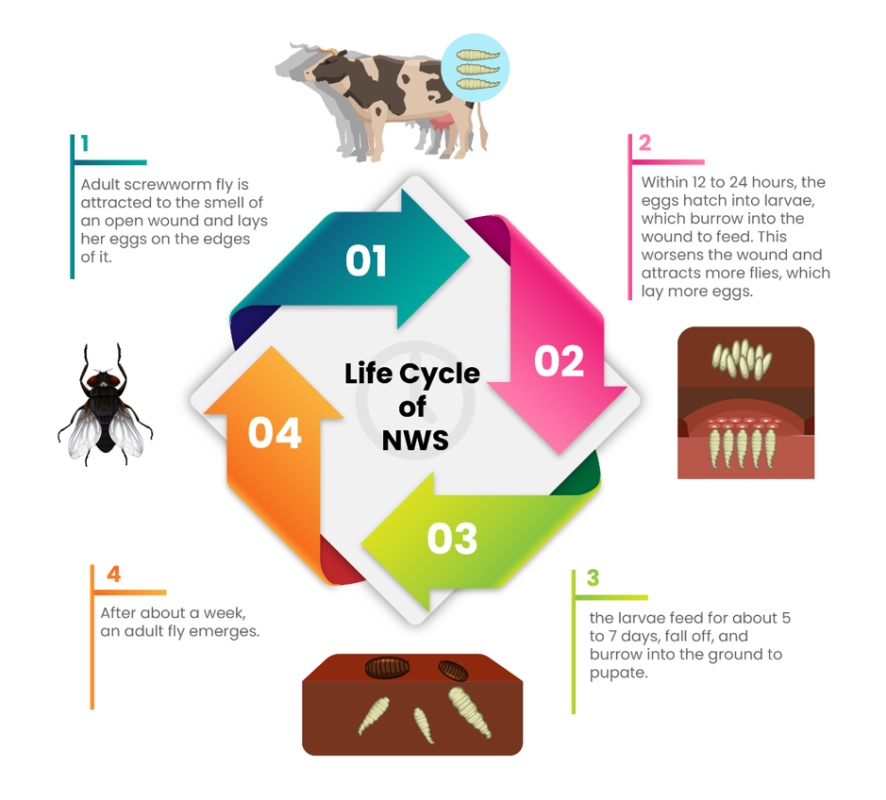
The New World Screwworm (NWS) is an infamous parasitic fly that has resurfaced in the United States after many decades. In early June 2026, the first case was reported in Zavala County (southern Texas), involving a three-month-old calf. NWS flies commonly target livestock, including cattle, by laying eggs in moist areas or open wounds. The larvae that emerge feed on the host animal’s flesh, causing an infestation called Myiasis. As the larvae feed, they worsen the animal’s wounds, attracting additional female NWS flies to lay more eggs. Without prompt treatment, an infestation can severely compromise the animal’s health and may ultimately be fatal.
The reemergence of NWS in the United States poses a significant concern for livestock industries in areas where the flies could spread. To date, 44 cases have been detected in the U.S., nearly all in western and southern Texas, with one case reported in southeastern New Mexico. About half of the cases involve infected cattle, making the situation particularly sensitive for Texas, which is the nation’s largest beef cattle industry in the US and is among the top five milk-producing states.
This recent outbreak of NWS could impose substantial economic costs on the livestock sector, as previous NWS outbreaks have done. Increased animal mortality could reduce domestic beef supply, placing additional pressure on an existing shortage that has already driven up beef prices.
The current outbreak began spreading through much of Mexico in 2024. As of early July 2026, Mexico had reported 19,880 total bovine cases. In response, the United States and Mexico have begun collaborating to contain the spread of NWS and eradicate the outbreak. USDA first temporarily suspended imports of live cattle, bison, and horses originating from or transiting Mexico on November 22, 2024. Restrictions were reduced on January 31, 2025, for animals entering through APHIS-approved facilities after pre-clearance inspection and treatment. However, on May 11, 2025, the USDA again restricted imports through U.S.-Mexico land-border ports, following continued northward movement of NWS in Mexico. Although USDA announced a phased reopening plan in June 2025, that plan was paused on July 9, 2025, after Mexico reported a new NWS case in Veracruz. USDA has since announced a new phased reopening. Beginning August 24, 2026, the Douglas port of entry (Arizona) is scheduled to reopen to cattle trade from Mexico, contingent on Mexico’s continued progress under the U.S.-Mexico Joint Action Plan. USDA will also consider reopening the Santa Teresa and Columbus ports entry in New Mexico after assessing the results of the initial reopening and associated risks.
A method that successfully eradicated NWS in the past is the Sterile Insect Technique (SIT), which involves producing sterilized male NWS flies and releasing them into the wild. This STI is being implemented again, supported by the construction of additional production facilities, including a recent $25 million investment to build a new fly dispersal facility in Arizona.
What could this outbreak mean for California, the largest milk producer in the US? Most of the California dairy industry is concentrated in San Joaquin Valley, the central area of the state. Although California shares a border with Mexico, no NWS cases have been reported in the state so far. One encouraging sign is that Baja California, Sonora, and Chihuahua (Mexican states near California) have reported relatively few cases. For now, the federal government continues to monitor the situation and deploy a range of measures to help stem the spread of this parasite.
For more information, check out the USDA APHIS here, the USDA APHIS tracker, the SENASICA tracker, the AFBF, and the USDA NASS.
Additional References
U.S. Department of Agriculture. (2025, June 30). USDA announces the phased reopening of southern ports for livestock trade. https://www.usda.gov/about-usda/news/press-releases/2025/06/30/usda-announces-phased-reopening-southern-ports-livestock-trade
U.S. Department of Agriculture. (2026, July 24). USDA announces phased reopening of southern ports for livestock trade. https://www.usda.gov/about-usda/news/press-releases/2026/07/24/usda-announces-phased-reopening-southern-ports-livestock-trade
U.S. Department of Agriculture, Animal and Plant Health Inspection Service. (2025, July 9). Import alert: New World screwworm restrictions for live animals originating from or transiting Mexico. https://www.aphis.usda.gov/sites/default/files/import-alert-nws-mexico.pdf